Inspections, reports & checklists
— run by AI.
The agent does a consultant's job in minutes, not weeks — describe what you need, it builds your templates, workflow and dashboards. Your crew fills each record/form with a photo or a sentence — any sector.
No workshops, no waiting for a slot. Ask at 6 a.m. on site — the agent answers in seconds.
It used to be a consultant's job — workshops, spec documents, weeks before the first form.
The Tebelis Agent is that consultant — your workflow is live before the kickoff meeting would have started.
On site, hands full —
the form fills itself
The same workspace, in your pocket. iPhone and Android, English and French, light and dark.
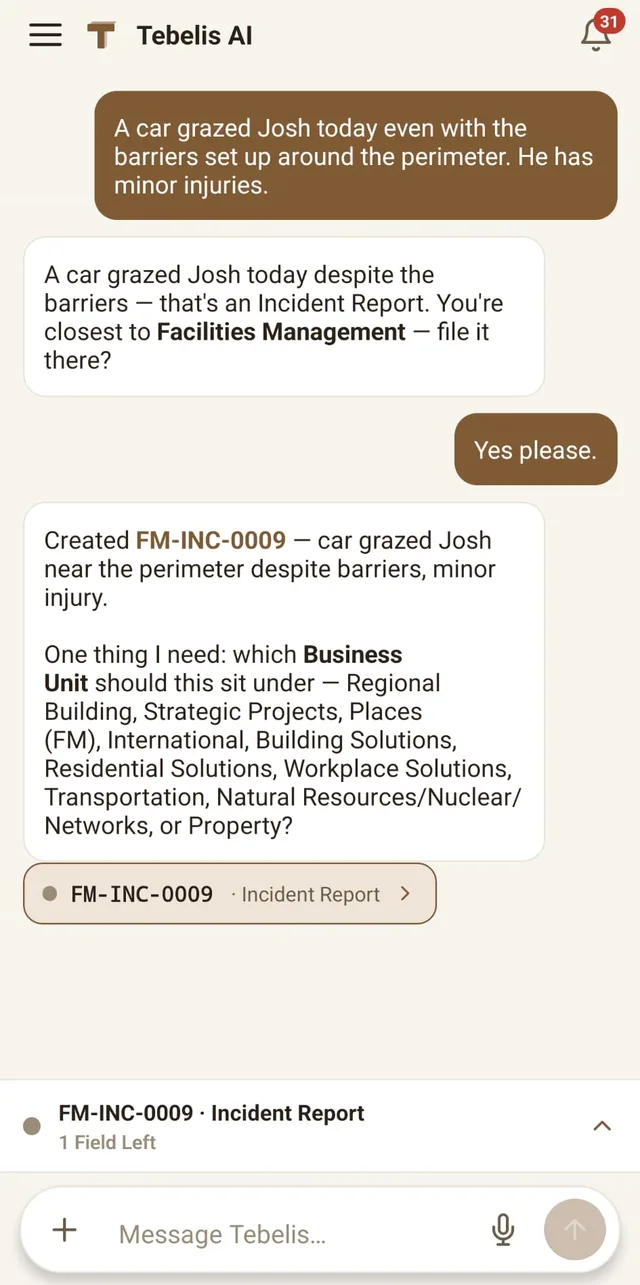
Speak — it files itself
Dictate or type what you saw. The assistant picks the right form, fills it in, and asks only for what's missing.
Your tasks follow you
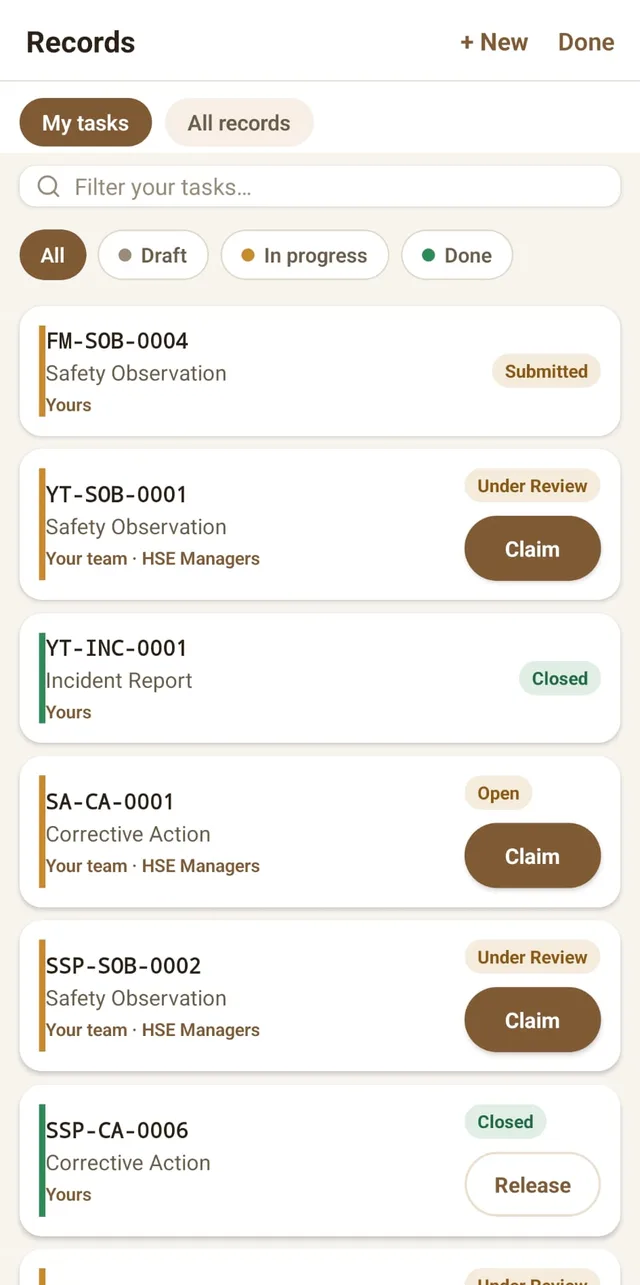
Approvals, reworks and hand-offs land in your queue with a notification — claim and act in two taps.
No signal? Keep working
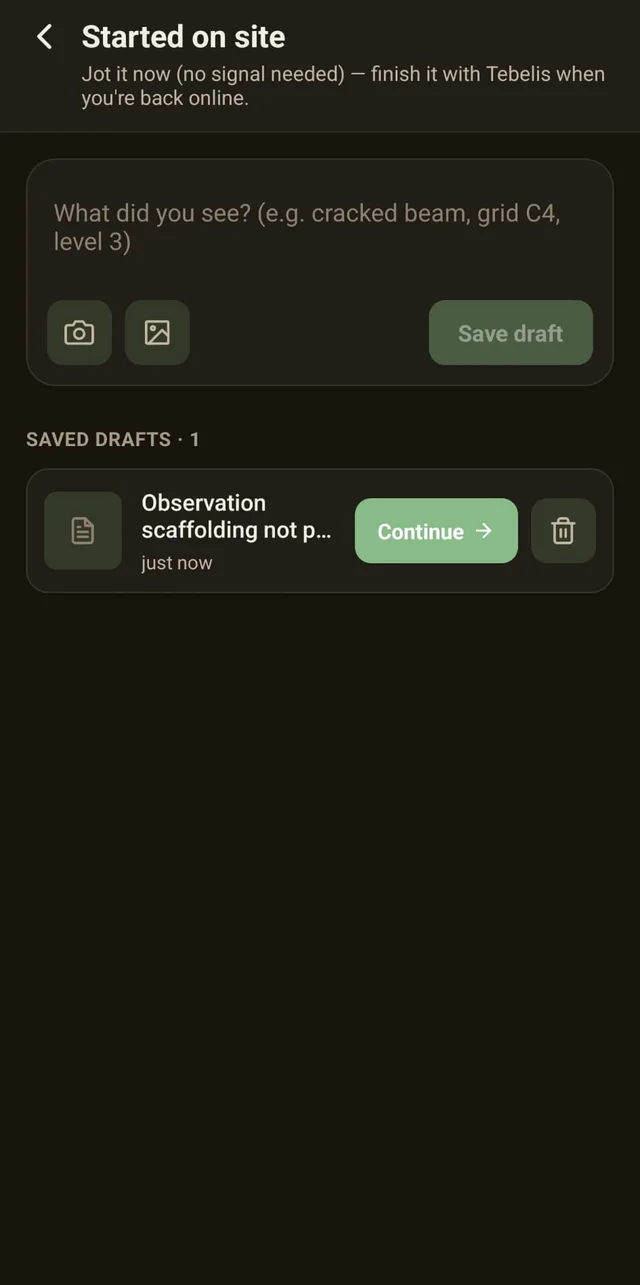
Jot notes and photos offline on site; finish the record with the assistant once you're back online.


Apple, the Apple logo, App Store, Google Play and the Google Play logo are trademarks of their respective owners.
Describe a process. Watch it build.
Tell the agent what a record/form is for — "daily concrete pour with a slump test and a corrective-action field that only shows when it's out of range" — and it assembles the template, fields and conditional rules. You review and publish.
- Fields, types & conditional rules
- Versioned on publish
- Live mobile preview
Describe it. The agent files it.
A worker snaps a photo or types a sentence; Tebelis drafts the record/form with the right template, fields, severity and location — then tells you exactly what's missing before it's submitted. Nothing invented.
- Photo & voice capture
- Auto-filled from your own templates
- You review & submit — always
Live dashboards, exact at any scale.
Ask in plain language — "add a cycle-time widget for the corrective action process" — and the chart lands on a saved dashboard. Break records/forms down by their own fields, exact even at hundreds of thousands of records/forms.
- Charts on any form field, colour-coded to match
- Cycle time per workflow step — see the bottleneck
- Board filters, CSV & PDF exports
It tells you what needs you.
Open Tebelis and the work is already triaged — every project ranked by how much it needs your attention, and why. One tap turns that into a plain-language brief of what to look at first, across the whole portfolio.
- Projects ranked by attention, automatically
- A one-tap AI "what needs you" digest
- No dashboards to build first
It reads what's actually going on.
Open a project and Tebelis reads it for you — not just what's open, but the patterns underneath: an adverse result trending up, a location that keeps coming back, work stuck in review. It checks each signal against your own records/forms before it speaks, and surfaces what's worth a closer look — framed as adjacency, never a guaranteed cause.
- Trends and hotspots across your own forms
- Each signal validated against your own data
- A plain-language read, with links you can act on
One agent.
Every tool you have.
The same agent operates the whole app — templates, records/forms, dashboards, workflows, people. It inherits your permissions; it does nothing you couldn't do yourself. Explore the platform
Templates that build themselves.
Type "weekly safety inspection" or "daily food-hygiene check" — get a structured template with conditional rules. Editing publishes a new version; old records/forms keep the version they were filed under.
Talk. Don't type.
Crews fill records/forms by voice, snap a photo to auto-create one, or chat with the agent. iOS & Android.
Dashboards that author themselves.
Ask "out-of-spec readings by location, last 30 days" — get a chart, save it. Every widget remembers the prompt that built it.
Every record/form, anchored.
Pin records/forms to a node in your hierarchy — a building, a floor, a production line, a piece of equipment. The hierarchy isn't just a tree; it's how everything is found and rolled up.
States, transitions, auto-assignment.
Define per-template workflows: who owns each state, what transitions are allowed, what auto-routes, what locks for edit. The agent does the routing.
Permissions in plain English.
Seven permission keys, four built-in roles, custom roles, groups that only elevate. Org-tree cascade with project + location scoping. No checkbox matrices.
Bring your own brain.
Or use ours.
The agent loop, the tools, and the access controls all sit above a clean provider seam. Swap models without changing how your data is governed.
Managed by Tebelis
Runs on our platform model. Usage is metered against a plan budget — when the period budget is exhausted, the API stops before any model call. No surprise bills.
Your model. Your cloud.
On Enterprise workspaces, plug in any provider that speaks the Anthropic or OpenAI API shape. Tebelis points at your endpoint — any public https URL; usage is on your key, not capped by us. Test the connection before you save.
Three steps to live.
Set up your structure, describe your work, hand it to the crew.
Drop in your structure
Set up your projects and your hierarchy — site, building, floor, asset. Turn organisation and locations on only where you need them.
Describe your work
Tell the agent what each record/form is for. It drafts the fields, the rules, the workflow. You review, edit, publish.
Hand it to the crew
Field workers open the mobile app, sign in, and start filling — by voice, by photo, by chat.
Use cases
The same building blocks work wherever your records/forms live — inspections, audits, checks, incidents, sign-offs. The templates, terminology, and standards are yours to define; nothing sector-specific is baked in.
Explore the platformPricing
Simple per-seat pricing — start free, then activate Tebelis Core for the seats you need. The plans below map to what the platform actually gates.
Explore the platformSecurity
Every tenant is isolated at both the application layer and inside Postgres itself. A bug in one wall can't leak across the other.
Explore the platformFrequently asked.
What does 'one agent runs the platform' actually mean?
What industries does Tebelis work for?
Which AI models can it run on?
How is tenant isolation actually enforced?
What stops a malicious doc from telling the agent to send data somewhere?
Do you train on our data?
Can we run the AI on our own cloud?
Your setup team
is the agent.
Tell it what you need in plain language and it builds the forms, rules and workflow. Review, publish, and your crew is capturing in minutes — no consultants required.